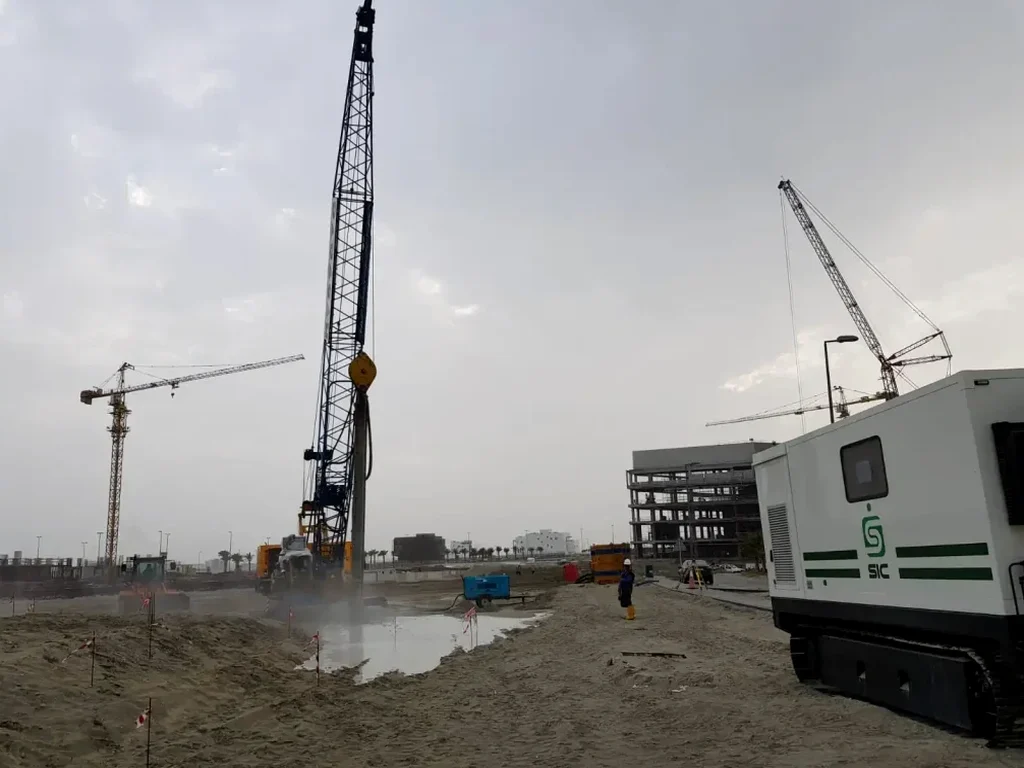
Corpus Christi’s transformation from a small trading post in the 1830s to a major petrochemical and export hub has pushed infrastructure onto challenging coastal plain deposits. As the city expanded across the Nueces and Oso floodplains, builders encountered loose, saturated sands that are notoriously difficult to compact with surface rollers. We design vibrocompaction programs that densify these liquefiable layers at depth, giving you a stable working platform for tanks, turbines, and heavy industrial structures. The process is validated with pre- and post-treatment CPT soundings, and we often tie the execution to a grain-size analysis program so gradation shifts are tracked from the start. For very soft interbeds, our team evaluates whether stone columns should supplement the densification grid without delaying the schedule.
A well-designed vibrocompaction grid in Corpus Christi can raise relative density from 40 to over 75 percent in a single shift, eliminating deep foundation overruns.
Local considerations
Corpus Christi sits at an elevation of just 2 meters above sea level, with a metropolitan population exceeding 420,000, placing critical infrastructure directly in the path of hurricane storm surge and seismic-induced liquefaction. The last significant felt event, the 2011 M4.8 earthquake near Fashing, was a reminder that the Gulf Coast is not seismically inert. Without deep densification, loose alluvial sands can lose over 60 percent of their bearing capacity when pore pressure spikes during a design-level event. Vibrocompaction directly mitigates this mechanism by rearranging grains into a denser state, but the design must account for the energy dissipation that occurs in silty sands. Our reports address residual liquefaction risk with post-treatment settlement estimates and, where needed, specify perimeter drains to handle excess water during the compaction process, keeping your site on schedule even when the water table is high.
Frequently asked questions
What is the typical cost range for a vibrocompaction design package in Corpus Christi?
Design fees for a medium-scale industrial lot in the Corpus Christi area generally run between US$1,660 and US$5,940, depending on the treated footprint, depth of liquefiable material, and number of verification borings required by the geotechnical baseline report.
How does the high water table in Corpus Christi affect vibrocompaction?
A shallow water table actually helps vibrocompaction by reducing intergranular friction, but it requires careful control of flush water to prevent sand boils. Our designs include a water management protocol that keeps the working platform stable while the probe reaches design depth.
Can vibrocompaction be used on the Beaumont Formation clays found in the area?
Vibrocompaction is only effective in granular soils with fines content below about 15 percent. For the cohesive Beaumont clays, we recommend alternative ground improvement such as stone columns or surcharge with wick drains, which we can design as part of a combined treatment plan.
How long does the design and permitting phase take before mobilization?
A typical design cycle runs three to four weeks: one week for site characterization and liquefaction analysis, one week for grid layout and specification writing, and a final week for client review and City of Corpus Christi permit coordination, assuming CPT data is already available.