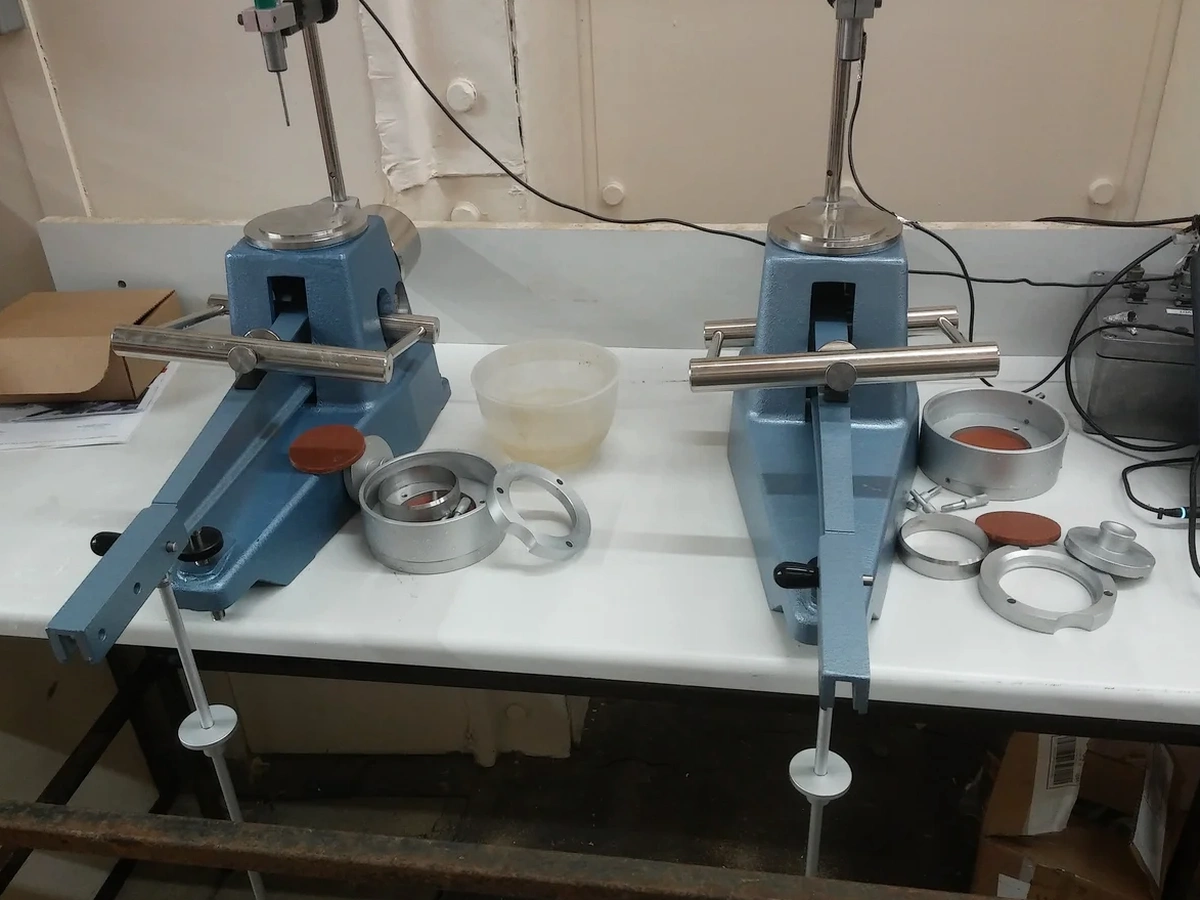
ASTM D4318 remains the controlling standard for Atterberg limits determination across Texas, and its application in Corpus Christi carries added weight due to the expansive Beaumont Formation clays underlying much of the city. With a population exceeding 315,000 and a coastal location averaging less than 10 feet above sea level, the city’s subsurface is dominated by high-plasticity fine-grained soils that swell when wet and shrink during the dry summer months. These volume-change behaviors directly influence foundation performance, pavement life, and retaining wall stability. The liquid limit, plastic limit, and plasticity index obtained from Atterberg limits testing provide the numerical basis for classifying Corpus Christi soils per ASTM D2487 (Unified Soil Classification System) and for predicting their engineering response. Our lab processes samples from across Nueces County, from the downtown marina district to the Calallen area, where clay mineralogy shifts notably within short distances. For projects involving shallow footings or slab-on-grade construction, these index values become critical inputs for geotechnical reports and pier design. We complement the Atterberg limits analysis with grain-size distribution when the fines content exceeds 50%, ensuring a complete classification.
Plasticity index values above 25 in Corpus Christi correlate with swell pressures that can exceed 2,000 psf, a threshold that changes foundation design from standard to post-tensioned or pier-supported.
Local geotechnical context
The risk profile for Atterberg limits changes markedly between Corpus Christi’s bayfront districts and the inland subdivisions south of Saratoga Boulevard. Near the bay, Holocene-age deposits contain interbedded clay and silty sand layers, and the plasticity index often drops below 15 — indicating low to moderate expansion potential. Move three miles west toward the Southside, and the same Beaumont Formation clay can yield a PI above 35, placing the soil in a high-expansion category per Texas Department of Transportation classification tables. A geotechnical report that omits Atterberg limits for a site on Everhart Road or Staples Street is effectively guessing about foundation movement. Post-tensioned slab designs for residential construction in Corpus Christi routinely rely on the PI value to calculate the required rib depth and reinforcement. Without these index tests, the engineer cannot assign an appropriate swell pressure or estimate the edge lift and center lift distortions that occur during prolonged drought. Commercial structures on shallow footings face similar uncertainty if the liquid limit and plasticity index remain unknown.
Questions and answers
What does the Atterberg limits test cost in Corpus Christi?
How long does it take to get Atterberg limits results in Corpus Christi?
Standard turnaround is three to five business days from sample receipt. We offer a 48-hour expedited service for projects on tight schedules, such as foundation investigations in the Southside or Calallen areas where construction timelines are weather-dependent. The clock starts once the sample has been properly conditioned and split in the lab.
Which ASTM standard applies to Atterberg limits testing?
ASTM D4318-17 governs the determination of liquid limit, plastic limit, and plasticity index of soils. The liquid limit is measured using the Casagrande cup method with a multi-point procedure, and the plastic limit is determined by hand-rolling soil threads at a moisture content where the thread crumbles at 3.2 mm diameter. Our lab also references AASHTO T-89 and T-90 for transportation projects in Texas.
Why are Atterberg limits important for foundations in Corpus Christi?
Corpus Christi sits on the Beaumont Formation, a Pleistocene-age deposit of high-plasticity clay that swells when wet and shrinks during drought. The plasticity index from Atterberg limits testing quantifies this volume-change potential. Values above 25 indicate high expansion risk, which directly determines whether a slab-on-grade foundation requires post-tensioning, deeper beams, or a switch to a pier-and-beam system. Without these numbers, foundation design is guesswork, and cracked slabs become a near certainty within the first five years.