← Home · Laboratory

Laboratory CBR Testing in Corpus Christi for Pavement and Subgrade Design

Together, we solve the challenges of tomorrow.

LEARN MORE →

In Corpus Christi, where expansive clay seams alternate with loose beach sands along the Oso Creek floodplain, we often see subgrade failures that trace back to an incomplete understanding of the soil's bearing capacity under moisture intrusion. The laboratory CBR test provides that critical number, correlating the soaked strength of a compacted specimen to the unsoaked baseline, which is exactly what the Texas Gulf Coast's seasonal groundwater swings demand. Unlike a field density check, this test quantifies how a subgrade will behave after saturation—a scenario that plays out every hurricane season from June to November. We run the procedure following ASTM D1883-21, compacting samples at optimum moisture from your Proctor data and soaking them for 96 hours before penetration. For projects east of SH 358 where the Beaumont Formation clays dominate, pairing this with an Atterberg limits evaluation helps us anticipate the swell potential that can undermine even a well-compacted base course.

A soaked CBR below 5% in Corpus Christi subgrade means you are designing for a pavement that will rut before the first heavy rain.

Methodology and scope

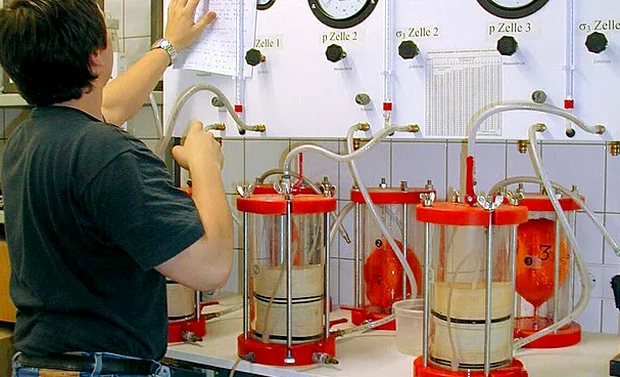
The test apparatus we operate at our Corpus Christi lab centers on a calibrated loading frame with a 10,000-lbf capacity and a piston traveling at 0.05 inches per minute—the slow, steady rate that ASTM D1883 requires to simulate years of traffic loading in a few minutes. We prepare a 6-inch-diameter mold, compact the soil in five lifts with a 10-pound rammer dropping from 18 inches, and then submerge the entire assembly in a water bath maintained at 71°F ± 3°F for four days. The load-penetration curve we record tells two stories: the unsoaked resistance reflects the soil's as-compacted condition, while the soaked value reveals the strength left after the Gulf's humidity has done its work. We calculate the CBR at 0.1-inch and 0.2-inch penetration, always reporting the higher of the two, and correct for any surface irregularities using the zero-correction method. When the project involves a flexible pavement section for a new subdivision off Saratoga Boulevard, we often recommend complementing the CBR with a field CBR correlation to validate the laboratory compaction curve against in-situ conditions.
Laboratory CBR Testing in Corpus Christi for Pavement and Subgrade Design
Technical reference image — Corpus Christi

Local geotechnical context

Corpus Christi sits on a geological patchwork of Holocene alluvium, Pleistocene-age Beaumont clay, and windblown Ingleside sand, meaning two lots half a mile apart can deliver CBR values that differ by a factor of three. We have tested samples from the Flour Bluff area that registered soaked CBRs below 3%, while material from a Calallen site exceeded 15% under the same compactive effort—a range that forces entirely different pavement structural numbers in the AASHTO 1993 design equation. The bigger risk is assuming a CBR from a borrow source without accounting for the compaction achievable with the contractor's rollers on a hot August afternoon when the moisture content evaporates faster than the sheepsfoot can chase it. We see this mismatch most clearly in residential streets built on the Oso Creek lowlands, where post-construction saturation drops the effective CBR into the sub-4% range and the asphalt mat begins cracking within two wet-dry cycles. A defensible CBR test program, executed with local moisture-density targets, prevents the kind of pavement rehabilitation that drains an HOA budget in under five years.
Need a geotechnical assessment?

Reply within 24h.

Email: contact@geotechnical-engineering1.org

Technical data

ParameterTypical value
Applicable standardASTM D1883-21
Mold diameter6.0 in (152.4 mm)
Compactive effortStandard Proctor (12,400 ft-lbf/ft³) or Modified (56,000 ft-lbf/ft³)
Soaking period96 hours minimum, submerged at 71°F ± 3°F
Penetration rate0.05 in/min
Surcharge weight10 lb annular weights per ASTM
Reported CBR valueHigher of 0.1-in and 0.2-in penetration ratio, corrected
Typical specimen quantity3 points per moisture-density curve

Related services

01

Standard CBR on Compacted Subgrade Soils

We compact the sample at optimum moisture content per ASTM D698 or D1557, apply the required surcharge rings, soak the specimen for 96 hours, and measure penetration resistance at 0.05 in/min. The final report includes the load-penetration curve, the corrected CBR value at 0.1 and 0.2 inches, and the swell percentage recorded during soaking. This test is the benchmark for classifying subgrades under the AASHTO flexible pavement design method and is accepted by the City of Corpus Christi Development Services for subdivision infrastructure submittals.

02

CBR with Swell Potential and Moisture Susceptibility

For Beaumont Formation clays that dominate the south and west sectors of Corpus Christi, we extend the standard procedure with a swell measurement taken every 24 hours during the soaking phase and a final moisture content determination on the top inch of the specimen. The swell-versus-time curve, when plotted alongside the CBR, reveals whether the soil will lose bearing capacity primarily from saturation softening or from actual volumetric expansion. This distinction matters for pavement designers specifying a lime-stabilized subgrade layer—a treatment we see specified on nearly every commercial pad within the Oso Creek watershed.

Regulatory framework

ASTM D1883-21 – Standard Test Method for California Bearing Ratio (CBR) of Laboratory-Compacted Soils, ASTM D698-12 – Standard Proctor Compaction (reference for specimen preparation), ASTM D1557-12 – Modified Proctor Compaction (for high-stress pavement applications), AASHTO T 193 – The California Bearing Ratio (laboratory procedure aligned with ASTM D1883), TxDOT Tex-120-E – Laboratory Compaction Characteristics and CBR of Soils (Texas-specific variant)

Questions and answers

How much does a laboratory CBR test cost in Corpus Christi?
What is the difference between a laboratory CBR and a field CBR test?

The laboratory CBR per ASTM D1883 measures the bearing ratio of a soil compacted at a controlled moisture and density in a 6-inch mold, soaked for 96 hours to simulate worst-case saturation. The field CBR, often performed with a dynamic cone penetrometer per ASTM D6951, gives an in-situ point measurement of the existing subgrade at whatever moisture condition it happens to be in that day. The laboratory value is the one you use for pavement design because it represents the soil after construction and saturation; the field value is for quality control during earthwork. We recommend running both when the subgrade is highly variable—which describes most of Corpus Christi east of Weber Road.

Can you run a CBR test on lime-stabilized soil from my Corpus Christi project?

Yes, and we do it routinely for TxDOT and municipal road projects. The procedure is the same ASTM D1883, but we cure the lime-treated specimen in a sealed container at 104°F for 48 hours before soaking, following TxDOT Tex-120-E guidelines. The curing step is essential because lime stabilization gains strength through pozzolanic reactions that take time and elevated temperature; skipping it will give you a CBR that underestimates the field performance by as much as 40%. We have processed stabilized samples from the SH 44 expansion and the North Beach drainage improvements—both projects where the native clay CBR went from sub-4% to above 20% after treatment.

Location and service area

We serve projects across Corpus Christi and surrounding areas.

View larger map