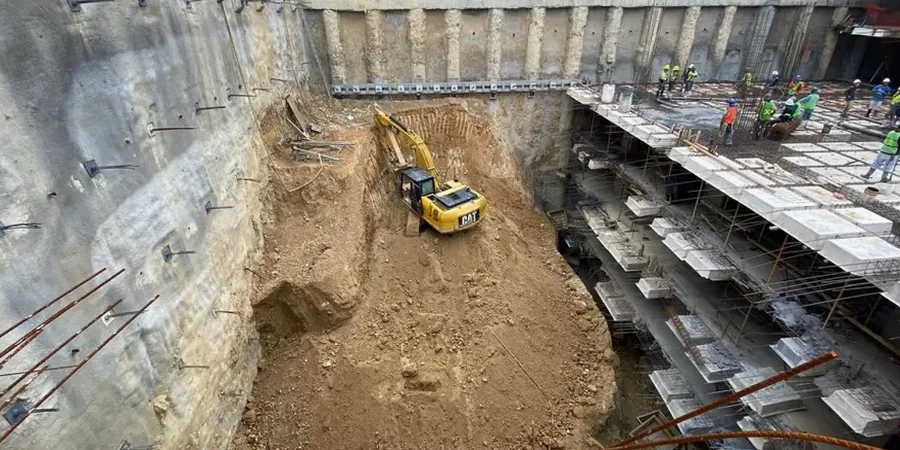
The Beaumont Formation clays that underlie most of Corpus Christi shift from stiff to plastic the moment you introduce water, and that transition governs nearly every deep excavation decision from the Harbor Bridge corridor down to the refineries near Taft. We see groundwater at barely six to ten feet below grade across the city, which means your excavation support system cannot be designed as a dry-hole exercise. The team analyzes undrained shear strength profiles, pore pressure dissipation rates, and lateral squeeze potential before sizing any shoring wall, because the difference between a stable cut and a creeping failure here often comes down to how the clay responds to stress relief during the dig. For projects where the near-surface sand lenses complicate open-cut stability, the scope frequently overlaps with slope stability analysis to verify global factors of safety before shoring installation even begins.
A deep excavation in Beaumont clay is fundamentally a race between excavation rate and pore pressure equalization — win that race and the shoring loads stay predictable.
Methodology and scope
The difference between excavating near the ship channel versus out toward Calallen is night and day. Near the channel you are dealing with Holocene alluvium, loose sands interbedded with soft clays that practically demand soldier pile and lagging walls with tieback anchors to control lateral deformation. Move west into the higher Pleistocene terraces and the clays are overconsolidated enough to stand on their own for weeks, though we still specify internal bracing when the adjacent right-of-way is tight. The design process always starts with a site-specific characterization of stratigraphy, but the real engineering comes in selecting a groundwater control method. Deep well systems work in the sandier pockets, but in the fat clays you are better off with a vacuum-assisted wellpoint setup. We reference ASTM D2487 for classification and ASTM D1586 for SPT-based strength correlations, then feed those values into finite element models that account for staged construction sequences, surcharge loads from nearby crane pads, and the cyclic vibration signature if a vibratory hammer is driving the soldier piles.
Local geotechnical context
Corpus Christi sits at an elevation averaging less than 30 feet above sea level, and with a population exceeding 316,000, the urban density along the waterfront means deep excavations routinely occur within feet of sensitive structures built on shallow footings. Lateral wall movements exceeding half an inch can propagate ground loss under adjacent roadways and utilities, triggering settlement claims that far outweigh the cost of a more conservative shoring design. The 2017 landfall of Hurricane Harvey proved how quickly a construction site can flood, which is why every deep excavation plan must include a stormwater contingency that prevents a flooded excavation from causing a bottom heave failure. We model the base stability using Bjerrum and Eide methods for clay, and if the factor of safety against basal heave drops below 1.5, the excavation sequence is re-staged or the wall is extended deeper into the bearing stratum. Saltwater intrusion in the coastal aquifer also accelerates corrosion of steel tiebacks, so we specify double-corrosion protection and epoxy-coated strand when the chloride concentration measured in the groundwater exceeds 500 ppm.
Regulatory framework
IBC 2021, Chapter 18: Soils and Foundations, ASCE 7-22, Section 12: Seismic Design Requirements, ASTM D1586-18: Standard Test Method for SPT, ASTM D2487-17: Unified Soil Classification System, FHWA Geotechnical Engineering Circular No. 4: Ground Anchors and Anchored Systems
Questions and answers
What is the typical lead time for a deep excavation design package in Corpus Christi?
A full design package with construction plans, technical specifications, and a geotechnical interpretive report typically takes three to five weeks. The timeline depends on whether the existing geotechnical data is sufficient or if supplementary borings, piezometer installation, and laboratory strength testing are needed to characterize the Beaumont clay profile at the specific site.
How do you address the risk of basal heave in the soft clays near the ship channel?
Basal heave is evaluated using undrained shear strength profiles from consolidated-undrained triaxial tests. If the factor of safety calculated via the Bjerrum and Eide method falls below 1.5, we either extend the shoring wall deeper into a competent stratum, install jet grout bottom plugs, or re-phase the excavation into smaller cells that reduce the unsupported span.
What is the cost range for a deep excavation design in Corpus Christi?
Do you provide construction-phase monitoring specifications for deep excavations?
Yes, the design package includes an instrumentation and monitoring plan specifying inclinometer locations, survey monitoring points on adjacent structures, and tiltmeter arrays. Threshold values for lateral wall deflection and ground settlement are defined based on the sensitivity of nearby infrastructure, with trigger levels for corrective action.
Are tieback anchors feasible in the expansive Beaumont clays?
They are feasible but require careful detailing. The bond length must be calculated using residual strength parameters, not peak, and the tendon bond zone must extend well into the overconsolidated stratum to avoid creep. We specify load testing on sacrificial anchors to verify the ultimate bond stress before production drilling begins.