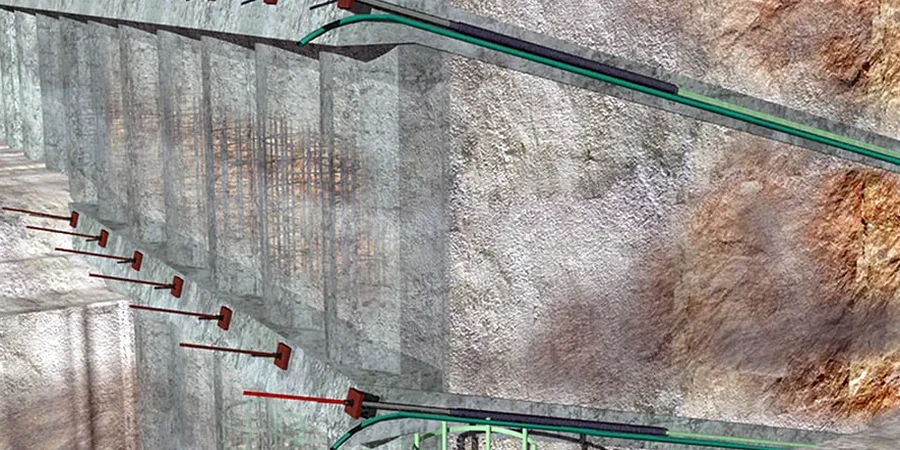
Anchor design in Corpus Christi has to account for a unique set of demands that standard textbook solutions rarely address. The Beaumont Formation clays that underlie much of the city expand and contract with seasonal moisture swings, while the Bayfront and Flour Bluff areas sit on loose, compressible deposits that lose strength when saturated. ASCE 7-22 requires uplift and overturning checks for the hurricane wind speeds mapped along the Texas Coastal Bend — 150 mph or higher depending on exposure category. Contractors and structural engineers who build deep excavations, floodwall tiebacks, or foundation underpinning here quickly learn that grouted anchors perform differently when installed through the stiff, dessicated crust versus the softer, normally consolidated clay below 12 feet. The slope stability implications matter too, particularly where seawall construction or channel widening exposes cut faces to tidal fluctuation.
Corpus Christi anchors in Beaumont clay can lose 15 percent of lock-off load within the first week — not from failure, but from natural creep relaxation that prestress cycling handles.
Methodology and scope
USGS geologic mapping shows Corpus Christi sitting on Pleistocene-age terrace deposits and Holocene floodplain silts, with groundwater often found within 6 to 10 feet of grade east of Staples Street. That shallow water table changes everything for anchor installation — open-hole drilling collapses fast in saturated silty sand, so cased methods or self-drilling hollow bars become the practical default. Active anchors lock off against a bearing plate after stressing, while passive anchors develop resistance only when the retained soil mass begins to move. Most temporary excavation support along the SH 358 corridor uses active tiebacks proof-tested to 133 percent of design load per PTI DC35.1 recommendations. Permanent anchors in Corpus Christi marine environments add a second layer of complexity: the chloride exposure requires double-corrosion protection with factory-extruded sheathing, heat-shrink field joints, and centralized grout cover verified by as-built records. Crews familiar with the local stratigraphy know to watch for the transition zone around 15 feet depth, where SPT N-values often jump from single digits into the 20s, and bond length calculations shift accordingly.
Frequently asked questions
How much does anchor design and testing cost for a typical Corpus Christi project?
For a standard retaining wall or excavation support package with a handful of tieback anchors, budget between US$1,040 and US$4,020 depending on the number of anchors, whether temporary or permanent corrosion protection is specified, and how many proof or performance tests the project requires. Permanent marine anchors with double-corrosion protection run toward the upper end because of the extra QA/QC documentation and encapsulated hardware.
What's the difference between an active and a passive anchor?
An active anchor is stressed and locked off against the structure immediately after grout reaches strength — it actively applies a compressive force to the wall or slab. A passive anchor doesn't get stressed; it only develops resistance once the structure moves enough to engage the tendon, so it's more common in rock bolts or soil nails where some deformation is acceptable before the system stiffens.
Why does the Beaumont clay in Corpus Christi affect anchor bond length?
Beaumont Formation clays here have a stiff, overconsolidated crust in the top 10 to 15 feet, underlain by softer, normally consolidated material. The transition zone can cause grout-to-soil bond stress to drop by half over just a few feet of depth. Longer bond lengths or post-grouting through tube-a-manchette systems compensate for the weaker zone, and pre-production testing identifies exactly where the bond stress reduction occurs.
Do permanent anchors in Corpus Christi need corrosion protection?
Absolutely. The combination of warm Gulf Coast temperatures, brackish groundwater near the Bayfront, and occasional salt spray from hurricane storm surge makes Class I double-corrosion protection mandatory for any anchor with a service life beyond two years. This means factory-extruded polyethylene sheathing over the full unbonded length, heat-shrink or O-ring seals at couplers and trumpets, and centralized grout cover verified with spacers every 10 feet.