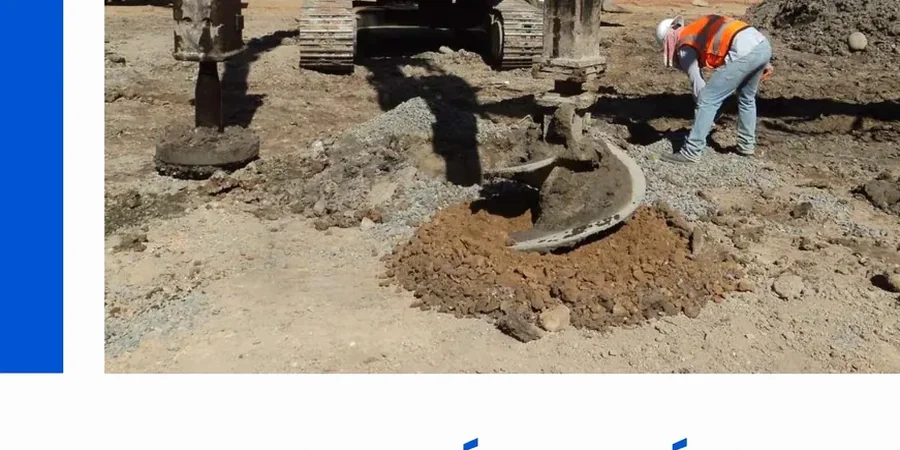
The vibroflot sinks into the silty clay at the Port of Corpus Christi, its water jets cutting a cylindrical hole while the crane operator watches the depth gauge. A front-end loader drops graded stone into the hopper, and the poker compacts it in lifts, forming a stiff inclusion that displaces the soft native material. In a city where the Nueces River delta deposited thick sequences of compressible clay and loose silty sand, and where the water table sits barely four feet below the pad, conventional excavation-and-replace becomes a dewatering nightmare. Stone column design offers a direct path to bearing capacity and settlement control without hauling off thousands of cubic yards of muck. Our team applies the priebe method for unit cell settlement and the cavity expansion model for ultimate capacity, cross-checking results with CPT soundings to confirm tip resistance and friction ratio through the compressible layers. For sites near Oso Bay where organic silt lenses appear, we pair the column grid with vibrocompaction in the upper sand strata to densify the matrix between columns.
A properly designed stone column grid in Corpus Christi bay clays can cut total settlement by half while doubling the allowable bearing pressure, all without dewatering.
Methodology and scope
A warehouse pad on the caliche-capped uplands west of Saratoga Boulevard behaves nothing like a tank foundation on the dredged fill behind the seawall on North Beach. The caliche site might need columns on a wide grid just to penetrate the cemented layer and reach competent material, while the bayfront fill requires a tight triangular pattern and a load-transfer platform of graded aggregate to bridge the soft zones between columns. We size the stone column diameter based on the vibroflot probe diameter plus the in-situ soil displacement ratio, typically yielding 30-inch to 42-inch finished columns in Corpus Christi clays with undrained shear strengths between 300 and 800 psf. Bearing capacity calculations follow the Hughes and Withers method, which accounts for the lateral confining pressure provided by the native soil, and we verify the improvement factor through post-installation modulus tests. For sites under IBC jurisdiction where the design must address a 2,500-year seismic event, the column shear modulus feeds directly into the site response model to confirm that the improved profile meets the Class D to Class C transition required by the geotechnical report.
Local considerations
The contrast between Corpus Christi's semi-arid uplands and its estuarine lowlands creates a risk profile that catches out-of-town contractors off guard. A site on the Flour Bluff peninsula might show stiff clay in August boreholes, but after a tropical storm dumps eight inches of rain in twenty-four hours, the same formation turns to jelly. If the stone column grid was designed using undrained strengths from dry-season samples without accounting for seasonal softening, the columns can punch through the weakened crust under load. We run the column design at the fully softened strength envelope, not the peak, and we specify a load test on a working column within the first week of installation. For tank foundations near the ship channel where cyclic filling and emptying imposes repeated loading, the stone column settlement under 10,000 cycles must stay within the operational tolerance of the piping connections. Our designs include a liquefaction trigger analysis for the sand layers interbedded with the clays, because excess pore pressure during a seismic event can degrade the lateral confinement that the stone column relies on for its vertical capacity.
Frequently asked questions
What soil conditions in Corpus Christi make stone columns the right choice over deep foundations?
When the compressible clay layer is less than about 60 feet thick and the undrained shear strength stays above 300 psf, stone columns can often eliminate the need for driven piles. Sites along the ship channel and in the Flour Bluff area frequently meet these conditions, especially where the clay is interbedded with sand seams that help drain pore pressure during installation.
How long does the design and installation process take for a typical commercial building pad?
The design phase runs two to three weeks after the geotechnical report is final. Field installation for a 10,000-square-foot pad with 120 columns usually takes five to seven working days with one crane and vibroflot, plus two days for modulus testing before the load transfer platform goes down.
What does stone column design cost for a project in Corpus Christi?
For a typical commercial or light industrial project in the Corpus Christi area, the complete design package and construction-phase oversight runs between US$1,630 and US$4,470, depending on the number of column locations, the complexity of the loading, and the required verification testing scope.
Can stone columns be installed through the caliche layers we find on the west side of town?
Yes, but it requires pre-drilling through the cemented caliche cap before the vibroflot can advance. We typically specify a 36-inch auger to cut through the caliche and then switch to the vibroflot for the underlying clay. The pre-drilled hole is backfilled with stone and compacted in the same sequence as the rest of the column.
Do stone columns work for tank foundations subject to frequent filling and emptying cycles?
They do, and they are common under storage tanks at the Port of Corpus Christi. The design must account for cyclic degradation of the stone column stiffness, so we run the settlement analysis at a reduced modulus after 10,000 load cycles and check that the differential settlement between the tank center and edge stays within the allowable for the tank shell and piping.