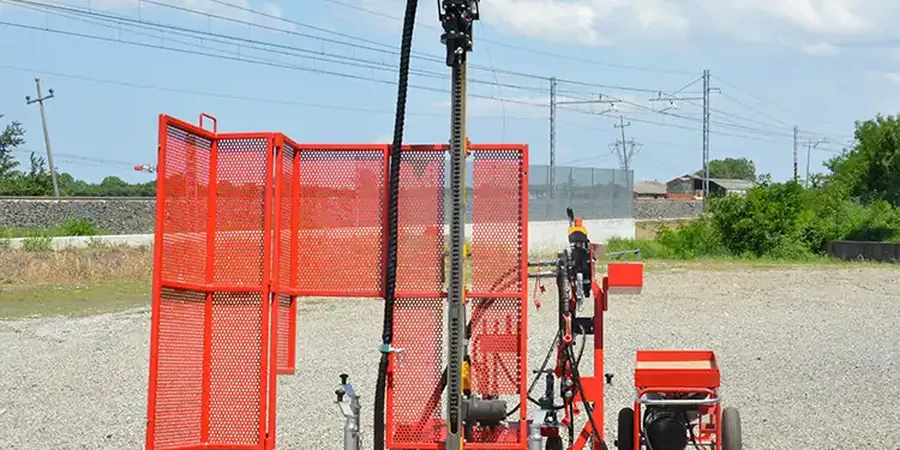
The CME-75 truck-mounted drill rig positions over the borehole point, its 140-pound safety hammer lifting on the cathead before the free-fall drop. That consistent 30-inch stroke is the working rhythm of every SPT job we run in Corpus Christi. The city’s subsurface shifts fast — beach sand on the island, hard clay north of Oso Creek, and those notorious Beaumont Formation stiff clays downtown. An ASTM D1586-compliant hammer energy calibration is non-negotiable here. We log blow counts every 6 inches, recover the split-spoon sampler, and bag the sample for the lab. For sites near the ship channel where fill is unpredictable, the grain-size distribution often confirms whether we are dealing with dredged material or natural deltaic sand. When refusal hits above the expected depth, we discuss switching to a CPT test for continuous profiling without losing data resolution.
N-values in Corpus Christi sand must be corrected for overburden pressure and hammer energy before any liquefaction assessment.
Methodology and scope
Southside subdivisions and Flour Bluff tell two completely different soil stories. Southside sits on thick Pleistocene clay that delivers N-values in the 12 to 25 range — competent but expansive. Flour Bluff, barely above sea level, gives you loose fine sand with N-values of 4 to 8 in the top 15 feet. That contrast drives every drilling decision. We adjust the casing depth, add mud rotary when the hole collapses in sand, and time the hammer drops to avoid premature refusal.
Our split-spoon samplers use the standard 2-inch OD with a 1.375-inch ID liner. Three 6-inch increments per test, summed to the N-value after discarding the seating drive. In the Corpus Christi Bay area, groundwater is typically within 8 feet of grade, so we record the water level at each rod break. For projects near Texas A&M-Corpus Christi where the Beaumont clay can be borderline hard, we pair SPT data with
Atterberg limits to nail down the plasticity index before foundation design proceeds. The hammer energy ratio is verified with a Pile Driving Analyzer trace every quarter — no guesswork on energy correction.
Frequently asked questions
What does an SPT test cost in Corpus Christi?
A single SPT boring with sampling at standard 5-foot intervals generally falls between US$560 and US$680 per borehole, assuming depths up to 50 feet and reasonable access. The total depends on mobilization distance, drilling conditions, and whether traffic control is needed for street work.
How many SPT boreholes does my Corpus Christi project need?
The IBC requires a minimum of one borehole per 1,600 square feet of building footprint for structures on shallow foundations, with at least three total. We follow the Texas Board of Professional Engineers guidelines and adjust spacing when the site straddles two distinct soil units — common near Oso Bay where clay and sand boundaries shift abruptly.
Can you drill SPT in the beach sand on Mustang Island?
Yes. Beach sand drilling requires hollow-stem augers with continuous casing to prevent hole collapse above the water table. We add bentonite mud when necessary. N-values in that loose dune sand are typically low, so we run liquefaction screening on every island project.