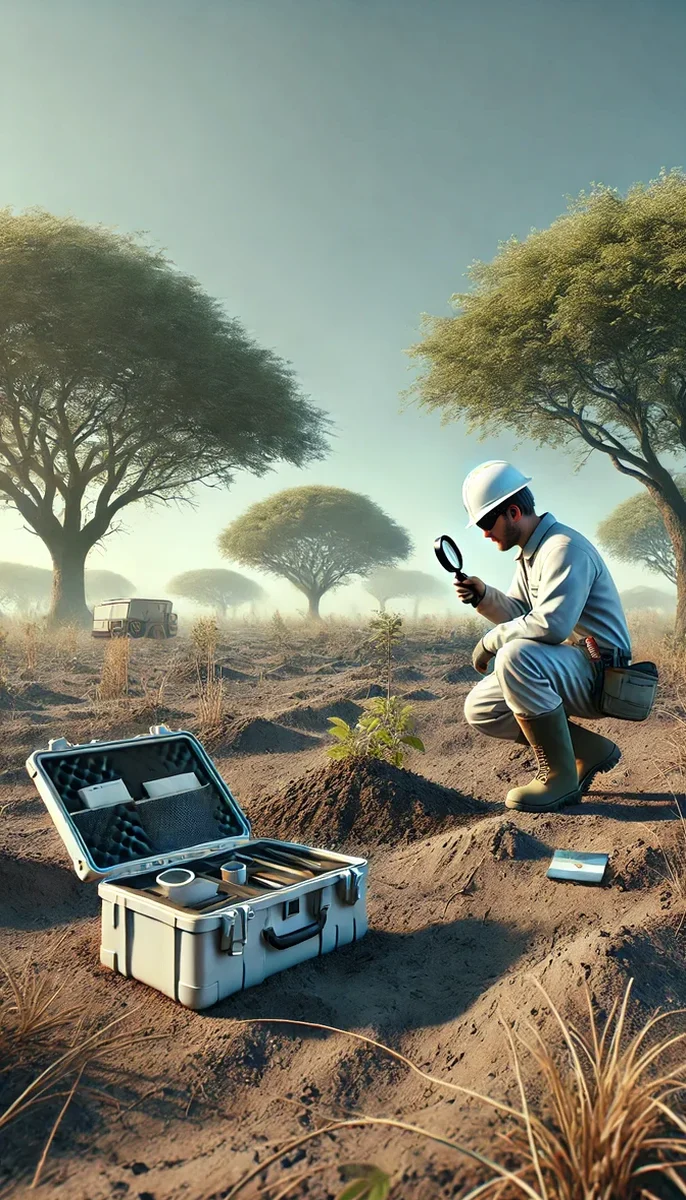
The Gulf Coast doesn't forgive assumptions. In Corpus Christi, a city built on Pleistocene terraces and Holocene floodplain deposits where the Nueces River meets the bay, soil behavior shifts dramatically within a single block. We've pulled samples from a site near North Beach that looked like firm sand in the morning, only to hit saturated fat clay lenses by midday. A proper soil mechanics study here has to decode that stratigraphic chaos. The hot, humid climate accelerates desiccation cracking in the upper 6 feet, while the shallow water table, often less than 8 feet deep across Flour Bluff, keeps the lower profile fully saturated. When you combine that with a population of over 317,000 and a construction market that hasn't stopped since the Harbor Bridge replacement kicked off, the margin for geotechnical error in Corpus Christi is razor thin. Our lab runs every sample through ASTM D2487 classification and measures shear strength under conditions that replicate actual field moisture, not some idealized lab state.
In Corpus Christi, the difference between a stable foundation and a lawsuit is the plasticity index of the Beaumont clay you didn't test.
Methodology and scope
The most expensive mistake we see in Corpus Christi is treating the Beaumont Formation clay as a uniform material. It isn't. A contractor pours a slab-on-grade near Southside, assumes moderate plasticity, and six years later the drywall is cracking from differential heave. What they missed was a pocket of montmorillonitic clay with a PI above 40, something a standard builder's sand cone test would never catch. Our approach ties the
Atterberg limits directly to the soil mechanics study, measuring liquid limit and plasticity index on every distinct stratum. We don't batch samples by depth; we batch by material type, even if that means running 30 tests on a single boring. For the compressible organic silts common in the Oso Creek corridor, consolidation parameters from an
in-situ permeability test dictate whether a conventional footing works or whether the owner needs to budget for a rigid inclusion ground improvement program. We've also found that contractors underestimate how quickly saline groundwater corrodes standard reinforcement. That detail changes the entire service life calculation.
Local geotechnical context
Corpus Christi sits at 27.7635 degrees north, squarely in the hurricane strike zone. The city's average elevation of just 7 feet above sea level means storm surge isn't a hypothetical, it's a design load. Hurricane Harvey dumped over 20 inches of rain here in 2017, saturating the vadose zone for weeks and triggering shallow slope failures in cuts along SH 358. A soil mechanics study that ignores transient pore pressure from surge inundation is dangerously incomplete. The Beaumont clay loses significant undrained shear strength when flooded, and we've measured Su reductions of 30% or more on remolded samples after just 48 hours of saturation. Combine that with the subsidence risk from groundwater extraction, which USGS monitoring wells have documented at rates up to 5 mm per year in parts of the city, and you get a compounding settlement problem that standard bearing capacity equations won't capture. For any structure with a design life beyond 20 years, the analysis has to model these coupled effects.
Regulatory framework
ASTM D2487 – Classification of Soils for Engineering Purposes (Unified Soil Classification System), ASTM D4318 – Standard Test Methods for Liquid Limit, Plastic Limit, and Plasticity Index of Soils, ASCE 7-22 – Minimum Design Loads and Associated Criteria (Chapter 20, Site Classification), IBC 2021 – International Building Code (Soils and Foundations, Chapter 18), ASTM D4546 – Standard Test Methods for One-Dimensional Swell or Collapse of Soils
Questions and answers
How deep do you typically need to drill for a soil mechanics study in Corpus Christi?
Depth depends on the foundation type and load, but for most commercial buildings on the Beaumont Formation, we drill to 30 or 40 feet. That gets us through the desiccated crust, into the saturated medium-stiff clay, and deep enough to evaluate the compressible layers that drive settlement. For deep foundations like drilled shafts on the Harbor Bridge project, borings went past 100 feet to reach the competent Pleistocene sand.
What's the cost range for a soil mechanics study on a typical commercial lot in Corpus Christi?
Does the high groundwater table in Corpus Christi affect the soil testing?
Absolutely. We measure groundwater during drilling and again 24 hours later for a stabilized reading. High groundwater changes the effective stress calculation, reduces bearing capacity, and complicates excavation. Our lab also runs unconfined compression and UU triaxial tests at natural moisture content to avoid the strength overestimation that happens when samples dry out during transport.
How do hurricane and flood risks get addressed in the soil mechanics report?
We incorporate FEMA flood zone data and site-specific hydrology into the geotechnical model. The report includes a section on scour potential, temporary dewatering requirements during construction, and recommendations for flood-resistant materials below the Base Flood Elevation. We also run shear strength tests on saturated samples to simulate post-storm conditions, since the undrained shear strength of Beaumont clay can drop significantly when flooded.